|
| UK STOPOVERS |
Motorhome FAQsPlease let us know of any further topics you would like to see covered here.
This page: Types - Licences
- Terms - Toilets - Buying
- Training - Seatbelts - Servicing
- Speed Limits - MOTs - UK
Road Tax - Road Tax abroad - TV licence - Overnight
parking - Storage - Towing
A-Class Coachbuilt Demountable Van Conversion Licences A question often asked is 'Can I drive a motorhome on my car licence?' If your motorhome is over 3.5 tonnes MAM but does not exceed 7.5 tonnes you will need to hold a driving licence that includes category C1 entitlement. If you passed your car test before 1.1.97 you will have C1 on your licence. If your licence does not include category C1 you may not drive a motorhome that exceeds 3.5 tonnes. If your motorhome exceeds 7.5 tonnes you will need a Category C (HGV licence). A common misapprehension was that, as a motorhome is not a 'goods vehicle', you could drive any size on a standard car licence, this is not the case. The DVLA have confirmed that the licence requirements apply to all vehicles.
Medical/age requirements:
UK regulations also impose restrictions on the size of motorhome that can be used on the road. Of particular interest to those wanting to use big American motorhomes is that it is illegal to use, or sell, a vehicle that is over 2.55m wide or over 12m in length. The Directgov website has a useful article on driving licence requirements and size regulations as they relate to motorhomes here. There has been some concern than new legislation means that some motorhome owners will have to take an additional driving test. We asked the Driving Standards Agency (DSA) to comment on the introduction of the driver Certificate of Professional Competence and the implementation of the EU Third Driving Licence Directive. We are are indebted to Nigel Lawson, from the Agency, for this comprehensive response (received 6/2/08):
Certificate of Professional Competence (CPC)
EU Third Directive on Driving Licences
What does that mean? Confused by the terminology? We'll try to help, some commomly used terms are listed below - If you come across a term you are not familiar with let us know and we'll add it to the list. Aire - The most commonly used term for official motorhome parking or service points in France, may also be refered to as Aire de Service, see our article . Be aware that motorway service areas and rest stops are also called Aires, or Aire de Repos. Air-rides - Proprietory name for spring assisters fitted to the rear axle, said to improve handling characteristics Black Water - waste from toilet holding tanks Cassette toilet- A very common type of toilet where the waste is held in a removable container, which you carry to a CDP to empty, see below for more details on toilets. CC - Caravan Club CCC or C&CC- Camping and Caravanning Club CDP - Chemical Disposal Point, for emptying toilets CL - Certificated Location, small sites often on farms, that are limited to 5 caravans or motorhomes, open to CC members only. The Motor Caravanners' Club also use this designation to identify sites approved by them, usually open open to all motorcaravanners. CS - Certificated Site, as above, but open to CCC members only FSH - Full service history Grey Water - waste water from sinks & showers GVW - Gross vehicle weight as marked on the vehicles VIN plate. It means the maximum amount the vehicle and all its contents can weigh. Now usually referred to as MAM or MTPLM. It is illegal to operate a vehicle in excess of the maximim weight marked on the VIN plate. LWB - Long wheelbase LPG - Liquified petroleum gas, comes in two types: Propane, good for all season use; butane, no good in the winter as it won't produce gas below 0°C MAM - Maximum authorised mass, see GVW Marine toilet - Toilet with a fixed waste holding tank, see below for more details on toilets. MCM - Motorcaravan Magazine, a popular magazine for motorhomers in the UK MHM - Motorhome Monthly, a popular magazine for motorhomers in the UK MMM - Motorcaravan, Motorhome Monthly, a popular magazine for motorhomers in the UK MTPLM - Maximum Technically Permitted Laden Mass, see GVW MVWP - MotorVan Waste Point, a road level dump point for motorhomes with on board grey or black water holding tanks PAS - Power assisted steering Payload - The weight of the extra items that you can carry in the motorhome after an allowance has been made for driver, passenger, water, fuel, gas and certain other essentials. PMH - Practical Motorhome, a popular magazine for motorhomers in the UK PIR - Passive infra-red, security device that detects heat sources RV - Recreational Vehicle, used in the USA to mean any type of camping vehicle, often used in the UK to refer to the large American motorhomes Silver Screens - Proprietory name for insulated covers for the cab windows SOG - A forced ventilation system for cassette toilets, see below. TD - Turbo Diesel. The engine is fitted with a turbocharger which uses energy from the exhaust to power a turbine which forces extra air into the engine air intake. This gives an increase in power. Many diesels are fitted with a turbo as standard, those without can be fitted with them by specialist companies. Top Box - A, usually plastic or fibreglass, storage box fixed to the roof of a motorhome Zig - Proprietory name of a company that produces caravan and motorhome electrical equipment, often taken to refer to a mains powered charger for the motorhome 12V battery
Toilets
Cassette toilet: A fixed toilet in the motorhome with a removable box (cassette) to hold the waste. Some types have a built in water tank for the flushing water, others use the onboard water tank. The cassette is accessed from outside the motorhome and is carried to a disposal point for emptying. This is the most common type to be found in motorhomes. Portapotti: Is a portable self contained toilet, usually in two parts, the top part comprises the bowl and incorporates a tank for the flushing water, tho bottom part is a removable waste tank that is carried to a disposal point for emptying. Marine toilet: Is a fixed toilet that is connected to a fixed waste tank in the motorhome, flushing water is usually from the onboard tank. As the waste tank is fixed you have to drive to a ground level disposal point for emptying which is accomplished by opening a valve and allowing the contents to drain out. This type of toilet normally has the largest capacity waste tank and is often to be found in American motorhomes and some European ones.
Chemicals
SOG
How can I keep my 'marine toilet' holding tank clean?
Seatbelts and the law
We asked the Department for Transport for their interpretation on the law as it applies to seatbelts fitted in motorhomes, this article gives the essence of the information that they gave us: The information below relates to the fitting of seatbelts and the wearing of seatbelts by adults. There is specific legislation, introduced in 2006, concerning the carrying of children in vehicles. Rather than trying to present all the somewhat complicated regulations here, please see: www.thinkroadsafety.gov.uk/campaigns/childcarseats/childcarseats.htm
For vehicles built up to Oxtober 2007 there was no legal requirement to have
seat belts fitted to side-facing seats or seats that make up the accommodation
area in motor caravans.
Seats in the rear of a campervan/motorhome did not, prior to October 2007, require seatbelts (whether forward, rearward or sideways facing) and it is not illegal to carry unrestrained passengers in them while travelling, providing the vehicle is not overloaded. It is not something we would recommend, however. Although current seat belt wearing regulations do not currently prohibit
carrying more passengers in vehicles than there are seat belts available,
the police may prosecute drivers for carrying passengers in a manner
that may injure someone. An EU Directive (2005/40/EC) on the installation of seat belts required that from 20 October 2007 new vehicles have to have seat belts fitted on all seats except those seats intended solely for use when the vehicle is stationary. Where seat belts are fitted, from May 2009, the seat belt wearing Directive will prevent more passengers being carried than there are seat belts in the rear of vehicles. This will mean that from May 2009, in any vehicle of whatever age, where seat belts are fitted in the rear, more passengers may not be carried in the rear than there are seat belts available. The critical point for owners of older motorhomes is that it will not become illegal to carry passengers in the rear, provided that no seatbelts are fitted to any seats behind the driver and front passenger seats. Owners of any motorhome that has belts fitted to any seat in the rear will need to be aware that, from May 2009, it will be illegal to carry passengers in any unbelted seats. The advisability of carrying unrestrained passengers is another matter, to quote the DfT spokesman: '... the police can already act where people in the rear of any vehicle are considered to be carried in a dangerous manner because they are unrestrained. [Owners] should beware of unbelted passengers. In a crash, they can injure others in the vehicle ...'. We are indebted to Rohan Pohl and Tom Norman from the Department for Transport for their time and patience in answering all our questions on this subject. MOTs for motorhomes There is sometimes confusion, even within the MOT trade, over the type of MOT test that motorhomes are subject to. Motorhomes are registered with the body type 'motor caravan', in the past this description was applied quite loosely but recently the DVLA and VOSA have been more rigid in aplying the regulations. In fact anyone registering a change of vehicle type after carrying out a conversion, or registering an imported motorhome, is likely to be required to have the vehicle checked at a VOSA Testing Station before DVLA will issue a new registration document. We asked VOSA about the regulations that apply to motorhomes, as far as the MOT test is concerned., with particular reference to motorhomes with garages, or other storage areas. The issue being that some Testing Stations were insisting that such motorhomes were 'Living Vans' and as such, if over 3500kg GVW, require a Class VII MOT test every year from new. The matter has now (17/11/06) been resolved by VOSA who state that it is up to the motorhome owner to declare if goods are to be carried, when submiting the motorhome for an MOT test. If a declaration is made that goods are not carried the Testing Station should accept that the vehicle is a 'motor caravan' and that a Class IV test is appropriate. Details of our discussions with VOSA can be found here What road tax (VED) should I be paying? Virtually all motorhomes with a revenue weight (equivalent to gross weight, MAM or MTPLM) of 3500kg or less should be taxed in the PLG category, all motorhomes with a revenue weight of over 3500kg should be taxed in the PHGV category - see our Motorhome Road Tax page for more information. Check your motorhome's tax disc, if you are paying £205 or £300 per year please let us knowDo I need to pay UK Road Tax if I'm travelling in Europe? As we understand it for all EU countries, all visiting vehicles must be road legal in their country of registration, which effectively means that you must have a current UK Road Tax disc and a current MOT Certificate. This may also be a requirement of your insurance company. Training The Caravan Club runs a limited number of motor caravanning courses, which are held mainly in the winter. They are designed for participants who are contemplating buying a motor caravan for the first time, or who have very little practical experience. Non-members are welcome. For further information, call the Club on 01342 336808. The Camping and Caravanning Club also run Motorhome Manoeuvring Courses. See their website for more details. Servicing It's important to have your motorhome properly serviced. This will certainly be a condition of any warranty that you have, and full service records will be a great asset when you come to sell your motorhome, not to mention the safety aspects of ensuring that all the equipment is operating as it should. The base vehicle should be serviced in accordance with the manufacturers instructions, and the accommodation part also needs an annual check over. The converter may well have a service schedule which you need to adhere to in order to maintain the warranty, and you may in fact need to take the motorhome to a workshop approved by the manufacturer whilst the warranty is in force. There is a standard checklist, produced by the Motorhome Section of the SMMT (Society of Motor Manufacturers and Traders) that provides guidance to dealers on what should be checked as part of an annual habitation service check. We have their permission to reproduce the checklist to help owners understand what is involved - and also so that they can ensure that a proper service has been carried out! The checklist can be found here. Speed Limits In the UK motorhomes are subject to the same speed limits as private cars, unless they exceed 3050kg unladen weight, or they are classed as 'living vans' which are subject to goods vehicle speed limits:
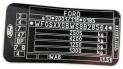
VOSA's definition of 'unladen weight' is: 'The weight of a vehicle inclusive of the body and all parts which are ordinarily used with the vehicle when working on a road. Unladen weight does not include the weight of water or fuel used for the propulsion of the vehicle, or of loose tools and loose equipment.' We take that to mean, in the case of motorhomes, the weight of the bare vehicle, without any posessions, portable equipment, water, gas, etc. Many motorhomes with a GVW of 3500kg or less will have an unladen weight of less than 3050kg, but if you are in doubt about the unladen weight of your motorhome you should get the figures from the motorhome manufacturer. See our page on motorhome speed limits for further information on UK limits. For limits in Europe please see our Foreign Touring Section. Do I need a TV licence? If you have a licenced TV at your home and you watch or record TV programmes on an additional TV in a touring caravan or vehicle, or a boat, you do not need a separate TV Licence; you will be covered by the TV Licence for your main residence. If the television in use in a motorhome is the only or main television then a licence will be required. These can be registered using the registration number of the vehicle and an address of a designated site (a permanent address or, most likely, the pitch which is used most regularly). For those people living and travelling in their motorhomes who don't have a regular pitch, a postal address where mail is received, such as an accommodation address or PO box can be used. Can I sleep in my camper when it's parked on the road or in a lay-by? It's very difficult to give a straightforward answer, the problem is that many bits of legislation may apply, including the Caravan Sites & Control of Development Act, and recent legislation covering gypsies and travellers. As a motorhome or campervan is classed in law as a 'caravan', sleeping in it may constitute 'camping'. Our interpretation of the law is that you cannot 'camp' on land in England & Wales (the law may be different in Scotland and N. Ireland) without the permission of the land owner. As far as the highway is concerned (this includes lay-bys) the land owner is normally the local authority. However, whether you are moved on or not will depend on the attitude of the local authority or the local police. Our opinion (and it is only an opinion) is that you are unlikely to be moved on if: The vehicle is not causing an obstruction (but remember that there is no 'right' to park any vehicle on the road); there is no specific local by-law prohibiting overnight parking or sleeping in vehicles; you are not in the same place for more than a day or two. Having said that, we don't encourage overnight parking other than at official sites (sometimes known as 'wild camping'), however we know that many people prefer it. Anyone considering it must be aware of the risks involved, and must have a responsible attitude to the local environment and other users of the location. As the old saying goes: 'Leave nothing but footprints, take nothing but photographs'. We know of several locations formerly used for overnight parking, that have been lost to all motorhome users because of the irresponsible actions of a minority. For what it's worth, during our 28 years of ownership of campers and motorhomes we have never been moved on from any lay-by or roadside stopping place in the UK - but we only use them as an overnight stop on a long journey. Many countries in Europe have networks of approved stopovers for motorhomes and there are moves to establish a similar provision in the UK. Some councils are starting to make provision for overnight stays by motorhomes, see this page for more information. I've bought a motorhome, but I don't have room to keep it at home You probably need to find a secure storage site, to satisfy your insurers. Have a look at www.cassoa.co.uk , they are a nationally recognised body providing an official register of safe and secure storage sites. They have a list of sites on their website. Alternatively, some campsites offer long term storage, you could try any that are local to you, just be sure that any site you choose is acceptable to your insurance company. How can I tow a car behind my motorhome?
Our view is that the safest method is to use a purpose designed trailer. There
are devices known as A-frames which allow a car to be towed directly, the
manufacturers of these devices will assure users that their use is legal.
For the Department for Transport's official view see this Note.
Basic buying advice for choosing a motorhome If you are completely new to motorhomes, the best advice is to look at as many different types as you can, there is no substitute for seeing a motorhome 'in the flesh' - they often look quite different to the pictures in magazines and manufacturers promotional material. The best places to see lots of motorhomes in one place are the motorhome shows that are organised around the country, we have a list here. A very good book, almost 'essential reading' for anyone considering buying a motorhome, is Go Motorhoming, written by Meli George and Chris Doree. It's full of useful information and even 'old hands' will learn from it. Complementing this is a new (2008) book from John Wickersham, The Motorcaravanning Handbook. It has a much more technical bias. If you want to get the feel of a motorhome before spending a lot of money, try hiring one. Check out the hire listings in our Directory for a company near you.
A motorhome, whether new or used, is a sizable investment. In addition to being a motor vehicle, it's a home. For many people, it's the second-largest purchase they will ever make. It's important to remember that whichever motorhome is selected, it probably will not be the last one purchased. Just as needs related to permanent housing change as a family changes, motorhome-related needs also change. Obviously, this article will not give the definitive answer to all of your questions, but perhaps it will provide the information needed to begin your search. Motorhome cost
The first question many people who have never purchased a motorhome ask is
about the cost.
How big?
Another frequent question is what size motorhome is needed. Buying a motorhome
is similar to purchasing a suit: You should purchase the one that fits you.
A size 52 suit is not the best purchase for a person who wears a size 44,
even if they both cost the same.
Lounging space Sit on the couches, are they comfortable, do you hit your head on the cupboards above? Is there space for a TV if you want one - can you see it easily from the seats? Decide if the layout will suit your lifestyle, some people like room to sprawl, others prefer to sit more upright Sleeping space
Several types of sleeping arrangements are found in motorhomes, you need to
decide which one is for you. Many have an over-cab sleeping space, but some
people find this claustrophobic - make sure that you can get up and down easily
and that there is sufficient headroom if you like to sit up in bed. Most motorhomes
have some beds that are made up from a seating area - pretend to make up the
bed to find out how easy it is and whether all corners can be reached easily.
Some people prefer a fixed bed that can be left made up in the daytime, but
you need to bear in mind that this may take up valuable space. The 'drop-down'
bed often found in A-class motorhomes can give you the best of both worlds,
a permanently made bed that is simply lifted out of the way during the day.
Make sure that you pull it down and push it up again to check how easy this
is. Climb into the bed, is it easy to get in and out, can you sit up in the
bed?
Kitchen No matter how small a kitchen is in a stationary home, it's probably larger than the one in a motorhome. Buyers must ask themselves what kind of meals they will prepare in this kitchen. Many pre-owned motorhomes feature ovens that have never been used. Many continental motorhomes have no oven or grill fitted. Perhaps a simple microwave or combination microwave-convection oven is sufficient if you intend to use electric hook-ups most of the time. If not, conventional ovens and other kitchen appliances are available to be retro-fitted. Make sure the galley has adequate storage for both the food that will be prepared and for the utensils and crockery that will be used to prepare it and serve it. Is there a spot big enough for the largest pan or portable appliance that will be used? Pretend to prepare a meal, is there enough room to cook whilst others are sitting in the seats? Do the drawers and cupboard doors work easily yet have some provision for not coming open as the motorhome is driven? Bathrooms Motorhome owners seem to fall into two categories when it comes to bathrooms. Some like large bathrooms, while others prefer to have the extra space utilised elsewhere in the motorhome, because of the relatively small amount of time spent in the bathroom or the fact that they always use the on-site facilities. Keep in mind that the water heater probably will hold only a few gallons, while the one at home will have a much greater capacity. Thus, frugality with the hot water may be essential. Obviously, the same is true when using the shower. Whichever style of bathroom is chosen, make sure it fits the your lifestyle and physical body. Take off your shoes and stand in the shower to see whether it has sufficient headroom and enough space to move comfortably. Also, sit on the toilet and make sure there is adequate room when the door is closed. The test drive When test driving a motorhome, it's a good idea to take it on a selection of road types of roads. It's unlikely that any motorhome will handle the same as a family car, but if you feel that it's too cumbersome, it will not be used as much as it should. Make sure the mirrors can be adjusted for good visibility. If vision to the rear or side is a problem, cameras and additional mirrors to minimize this problem are available and can be installed at any time. Also, make sure the co-pilot has a chance to drive the motorhome before purchasing it. Weight Ask the seller what the motorhome weighs. Ideally you should know the weight carried by each axle and compared them with the weight ratings given on the vehicle's VIN plate. If the seller doesn't know this information you should ask if the vehicle can be taken to a weighbridge for checking. If you find that your motorhome is overweight it may be possible to have the chassis upgraded on some models by specialist companies. An overloaded motorhome can be unsafe and illegal to operate. If the motorhome is empty, remember that water, fuel, tools, food, clothing, people, and all of the other things that go into most motorhomes will weigh hundreds of kilogrammes. The power, acceleration, and handling of the motorhome during a test drive may change once the vehicle is fully loaded. If possible, talk with other owners about their experience with the same motorhome. Other Concerns
If the motorhome being bought from a dealer, check the terms of any warranty.
Check to see whether the manufacturer is still in business. Although parts
such as pumps, water heaters, and windows are often made by various manufacturers
regardless of motorhome brand, parts such as body mouldings, trim pieces etc.
can be difficult or impossible to locate if the motorhome manufacturer is
no longer in business.
When owners are asked for a one-sentence summary of what they tell their friends
to do when contemplating the purchase of a motorhome the following advice
comes up time and again:
Remember, there is a new or used motorhome for just about every budget and every family. It just takes some time to find it. |
advertise in this section
sponsored links
MotorHomes Ltd
New, Used & Hire Best Prices/Service Motorhomes for Sale Over 100 Motorhomes motorcaravans and campers for sale online at Motorhome Market. Advertise for just £6.50 |
|||||||||||||||||||||||||||||||||||||||||||
|
Can't find what you want? Use Google to search our site or the web [home] [directory] [classifieds] [articles] [whats on] [exchange] [faqs] [links] [contact] [news] [advertise] [legal] This entire site © BM Services and UKMotorhomes.net. For more information on the services provided by UKMotorhomes.net please use our contact form |